


PEDLER: Full-Scale Validation of LECA® for Railway Embankments
Independent Research Confirming the Performance of Lightweight Railway Infrastructure
Reducing weight in railway embankments has long been recognised as an effective way to address challenges associated with soft soils, settlement control and load-sensitive structures. Yet one key question remains:
Can a lightweight embankment deliver the same long-term performance as a conventional railway solution?
The PEDLER project (Performance and Durability of LECA in Railway Embankments) was designed to answer exactly that.
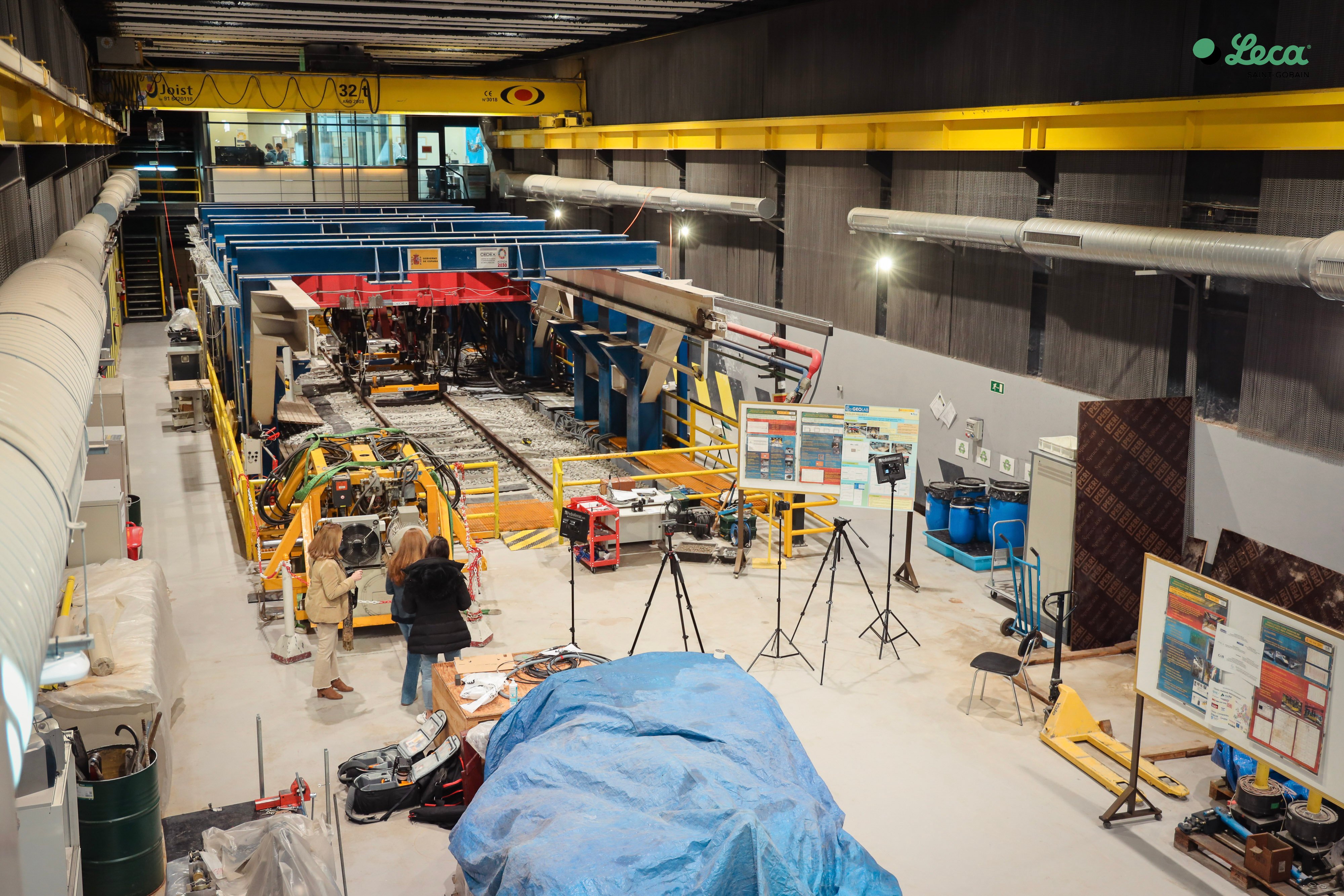
Developed within the European GEOLAB programme and tested at the renowned CEDEX Track Box facility in Spain, PEDLER provides one of the most comprehensive experimental investigations ever conducted on the use of LECA® Lightweight Expanded Clay Aggregate in railway embankments.
The project combined full-scale construction, advanced instrumentation and extensive testing under simulated passenger and freight traffic conditions to evaluate the structural behaviour, durability and long-term stability of a railway embankment built with LECA®.
What Was Tested?
The experimental railway section incorporated a LECA® embankment beneath the track structure and was subjected to a rigorous testing programme including:
- Static performance testing
- Dynamic testing under varying train speeds
- Fatigue testing with repeated loading cycles
- Passenger and freight train simulations
- Long-term settlement monitoring
- Measurement of stiffness, displacements, pressures, velocities and accelerations
The objective was to assess how a lightweight embankment performs compared with conventional railway earthworks under demanding operational conditions.
What Did the PEDLER Project Demonstrate?
Performance Comparable to Conventional Railway Embankments
The results showed that railway sections constructed with LECA® achieved stiffness, critical speed, sleeper velocity and acceleration values comparable to those recorded in conventional high-speed railway embankments.
This demonstrates that significant weight reduction can be achieved without compromising track performance or structural behaviour.
Key advantage: Reduce embankment loads while maintaining the mechanical response required for modern railway infrastructure.
Excellent Durability Under Repeated Railway Loading
A large-scale fatigue programme simulated the equivalent of more than one million passenger train axles and 400,000 freight train axles.
Throughout the testing campaign, the LECA® embankment maintained stable performance, showing no signs of significant degradation.
The results confirm that LECA® is capable of delivering long-term reliability under sustained railway traffic conditions.
Key advantage: A lightweight solution designed for decades of operational performance.
Long-Term Behaviour Governed by the Ballast Layer
One of the study’s most significant findings was that the ballast layer remained the primary contributor to long-term track deformation.
The contribution of the LECA® embankment to overall settlement and deformation was found to be minimal.
This confirms that the lightweight fill does not become the critical element controlling track performance over time.
Key advantage: The benefits of weight reduction are achieved without introducing additional long-term deformation concerns.
Outstanding Settlement Performance
Permanent settlements measured within the LECA® embankment were exceptionally low throughout the testing programme.
Recorded settlement rates were approximately 0.04–0.05 mm per million tonnes transported, demonstrating excellent dimensional stability under repeated loading.
Key advantage: Reduced settlement helps preserve track geometry, improve operational reliability and minimise maintenance requirements.
A Proven Solution for Complex Geotechnical Conditions
The PEDLER project confirms that LECA® can provide a technically robust alternative to conventional embankment materials in railway applications where reducing self-weight creates a clear engineering benefit.
Typical applications include:
- Railways over soft or compressible soils
- Bridge approaches
- Infrastructure rehabilitation projects
- Load-sensitive structures
- Areas with strict settlement requirements
- Sites with limited availability of suitable fill materials
Why This Matters for Railway Design
As rail networks expand and infrastructure projects increasingly face challenging ground conditions, engineers require solutions that can reduce loads without compromising safety, durability or performance.
The PEDLER project provides independent evidence that lightweight embankments built with LECA® can meet these demands.
By combining low density, long-term stability and proven mechanical performance, LECA® offers a practical solution for designing more efficient and resilient railway infrastructure.
Download the PEDLER Final Report
The PEDLER Final Report provides detailed insight into the methodology, testing programme and results obtained during this full-scale experimental campaign.
Download the report to explore:
- Full-scale railway testing at CEDEX Track Box
- Static, dynamic and fatigue test results
- Passenger and freight train simulations
- Settlement and durability analysis
- Performance comparisons with conventional railway embankments
- Technical data supporting the use of lightweight embankments in railway infrastructure
Download the PEDLER Final Report and discover how LECA® can help deliver lighter, more efficient and more resilient railway embankments.
 preview

